
Romanian Public Broadcaster Airs Independent Documentary That Shakes the Justice System
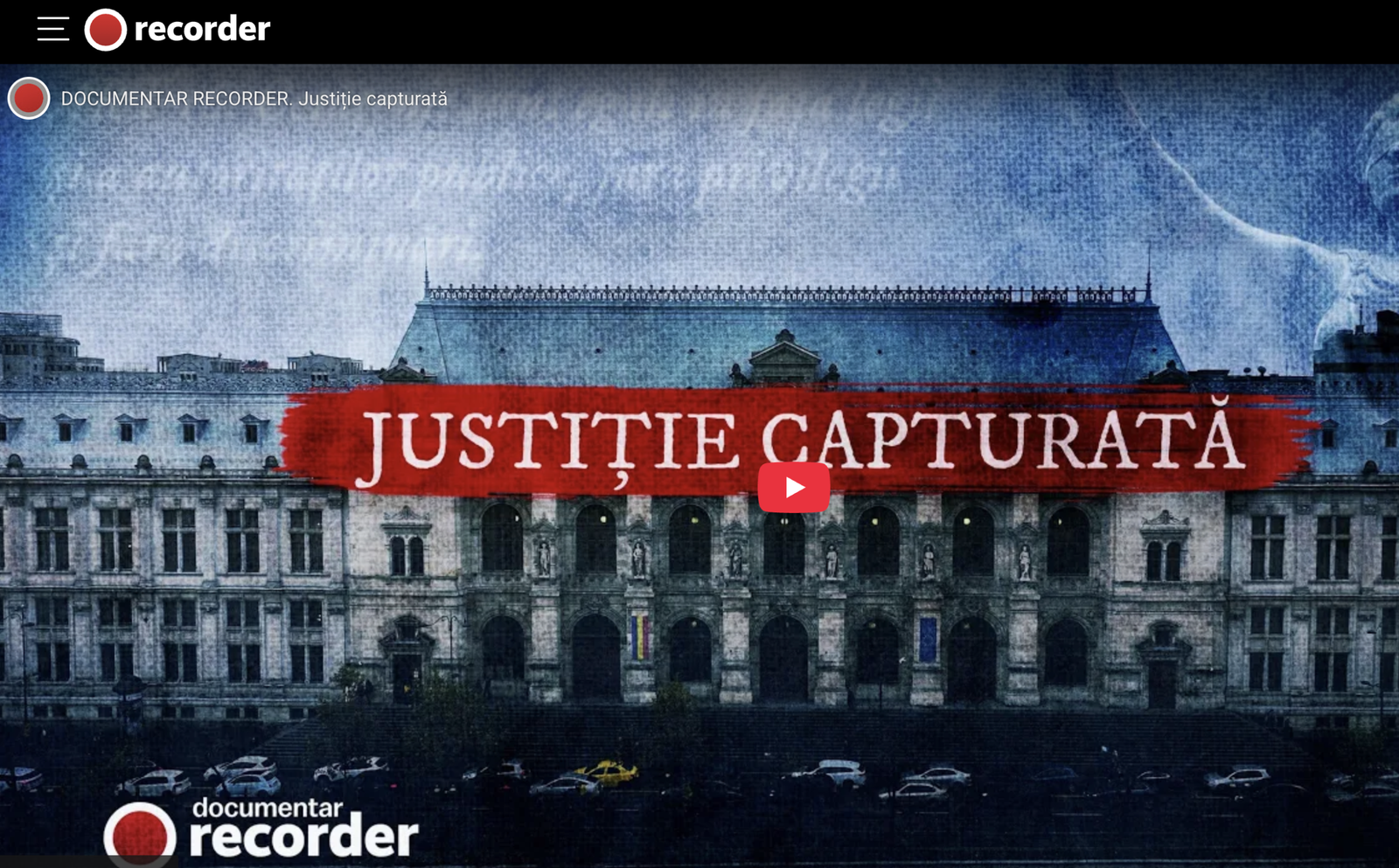
Romania’s latest institutional crisis did not originate in parliament or the courts, but in investigative journalism, and, crucially, in an unexpected editorial decision by the country’s public broadcaster. The scandal surrounding Romania’s justice system was triggered by Recorder, an independent investigative outlet, whose documentary Justiție Capturată (“Captured Justice”) detailed alleged patterns of obstruction, internal protection networks, and accountability failures within the judiciary. What turned the investigation into a national turning point was TVR’s decision to broadcast the documentary in prime time, a move that challenged long-standing assumptions about the broadcaster’s political dependence and editorial limits.
Recorder has emerged over the past decade as one of the most influential actors in Romania’s media ecosystem precisely because it operates outside traditional power structures. Funded largely through public donations and digital subscriptions, the outlet specializes in long-form investigations that scrutinize state institutions and political elites. Justiție Capturată followed this model, relying on court documents, interviews with magistrates, and case analysis to argue that parts of the justice system have become structurally insulated from accountability.
On its own, the documentary had already generated strong online engagement. But its broadcast on TVR transformed it from a digital investigation into a national media event. For Romania’s public broadcaster, frequently criticized by researchers and civil society for political interference, parliamentary control over governance, and editorial caution, the decision was widely perceived as a break with precedent. TVR has historically avoided programming that directly confronts powerful state institutions, particularly the judiciary. Airing Recorder’s investigation signaled an unusual willingness to test the boundaries of public service journalism.
This editorial shift coincides with a leadership change at TVR that has attracted intense scrutiny. In late 2025, Romania’s Parliament voted to appoint Adriana Săftoiu as Director General of TVR, replacing the previous management, in a process shaped by partisan negotiation within the governing coalition. Săftoiu is a former journalist and career political communicator who served as spokesperson to the Romanian presidency in the 2000s and was previously a member of parliament, and is widely described in media reporting as having close links to political elites. Observers note that her appointment represents a significant moment for TVR’s governance at a time when questions about editorial independence and political influence are being intensely debated.
The audience response underscored the significance of the decision. According to audience data cited by HotNews, the documentary recorded one of TVR’s highest viewership figures of 2025, surpassed only by the presidential electoral debate, outperforming virtually all regular programming on the channel. In effect, an investigation produced by an independent online newsroom was amplified by public television into a mass audience intervention, reaching viewers far beyond Recorder’s core digital base.
The backlash from within the justice system was swift and revealing. Senior judicial figures, including the president of the Bucharest Court of Appeal, publicly condemned both the documentary and its broadcast, framing the program as an attack on the constitutional order. The language used went well beyond standard institutional criticism and was widely interpreted as an attempt to delegitimize both the journalists and the broadcaster that aired their work.
What made this episode particularly notable from a media power perspective was the response of the regulator. The National Audiovisual Council (CNA), which has itself been criticized in the past for political alignment, publicly defended TVR’s decision. CNA vice president Valentin-Alexandru Jucan rejected the judiciary’s accusations and argued that broadcasting investigative journalism on matters of public interest falls squarely within the mission of public service media. In a media system where regulators have often acted cautiously, the CNA’s stance reinforced TVR’s editorial choice rather than undermining it.
According to Marius Dragomir, director of the Media and Journalism Research Center (MJRC), the developments are being examined as part of the State Media Monitor, the largest global mapping project of state- and publicly owned media. “Our team working on the State Media Monitor is currently analyzing whether TVR’s recent editorial decisions could justify a reassessment of its classification,” Dragomir said. “A single broadcast does not transform an institution overnight. But when a public broadcaster withstands political and judicial pressure to air a high-impact investigative documentary, it raises legitimate questions about whether its level of editorial independence is improving.”
Whether this episode marks the beginning of a broader editorial shift at TVR or remains an isolated exception will depend on future programming choices, the durability of regulatory support, and the political consequences for the broadcaster’s leadership. For now, Romania offers a rare case study in how independent journalism, when amplified by public television, can momentarily rebalance media power, and force both the justice system and the media system itself into the center of public scrutiny.