
Meet the Project That Maps How Newsrooms Use AI—and Reveals What They Are Missing
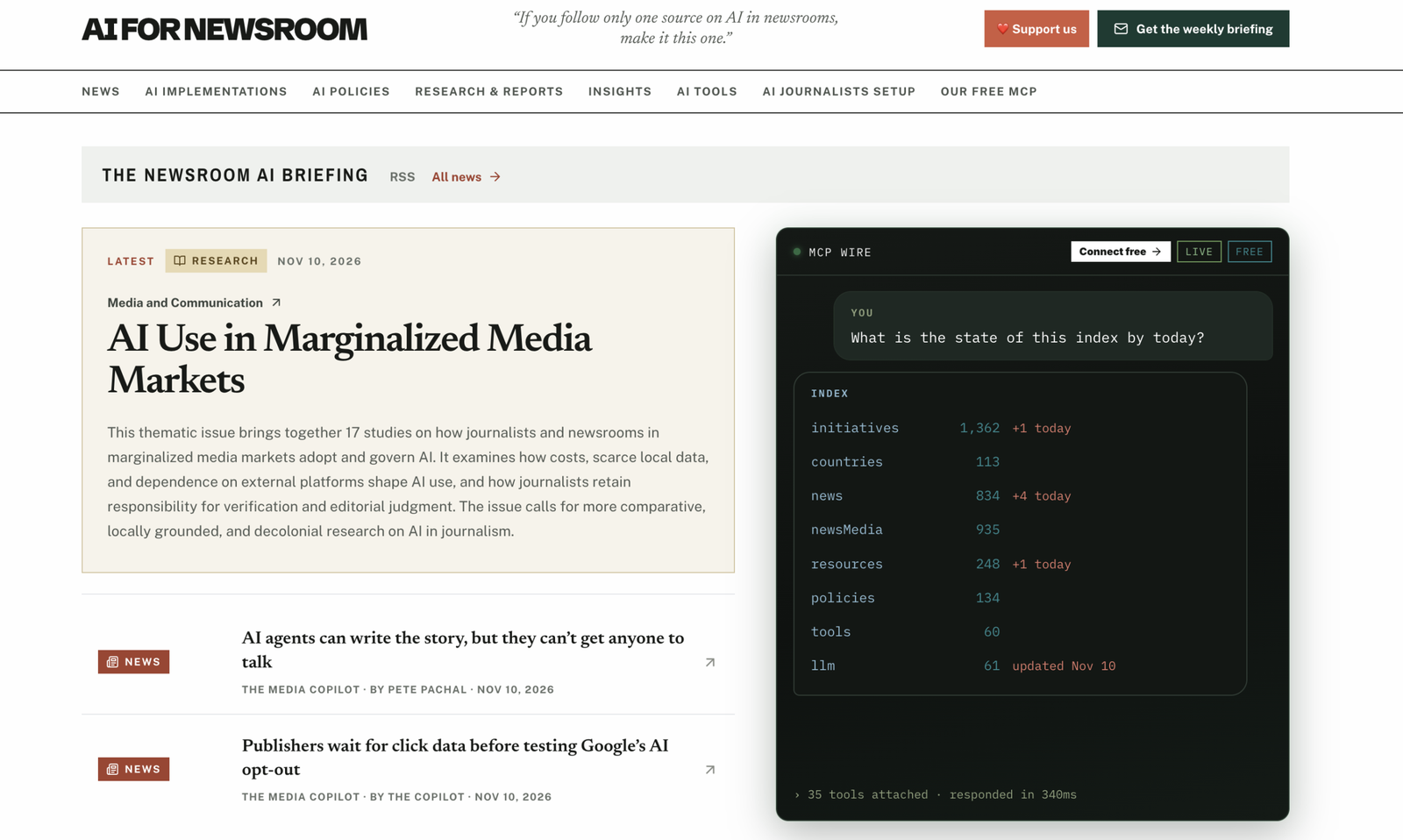
With more than 1,360 documented initiatives worldwide, AI For Newsroom offers an unusually detailed picture of how journalism is embracing artificial intelligence. MPMonitor examines why this independent project matters and what its findings reveal.
Artificial intelligence is transforming journalism, but keeping track of what news organizations are actually doing with the technology has become increasingly difficult. New applications, experiments and partnerships are announced almost daily, making it hard to distinguish meaningful innovation from technological hype.
One independent project is bringing much-needed clarity to this landscape.
AI For Newsroom, developed by Lisbon-based media consultant Sergei Yakupov, has assembled a searchable database of more than 1,360 AI initiatives involving approximately 935 news organizations across 113 countries.
Of the projects mapping newsroom AI initiatives that MPMonitor has examined, AI For Newsroom stands out as the most accurate and practically useful. Its strength is not simply the number of entries, but the attention to concrete implementations, detailed descriptions and supporting sources.
Rather than counting every instance of a journalist experimenting with ChatGPT, the project concentrates on identifiable tools, newsroom workflows and organizational initiatives. This narrower approach makes its findings particularly valuable for understanding how AI is being incorporated into the actual production and business of journalism.
From a spreadsheet to a global resource
Yakupov, who has spent 25 years working in the news industry, originally began collecting examples of newsroom AI applications in a Google spreadsheet.
The initiative has since evolved into a substantial information platform combining documented implementations, newsroom AI policies, research reports, practical tools and a regularly updated news service.
Users can search for initiatives by country, organization or application. The project also offers free access through an interface allowing AI assistants to interrogate its database and produce customized research summaries.
This accessibility is important. Until recently, knowledge about newsroom AI innovation was scattered across conference presentations, corporate announcements, research reports and specialist publications. AI For Newsroom brings much of this information together in a structured, searchable format.
For smaller publishers, researchers and media-development organizations, the resource offers something particularly valuable: the ability to discover what others are building without having to undertake extensive research themselves.
What the numbers reveal
The project’s July 2026 report, analyzing 1,000 documented initiatives across 105 countries, provides several revealing findings.
First, content production dominates AI innovation. Nearly half of all documented initiatives, 49%, concern content creation and automation. Audience engagement accounts for 16%, while journalism-support tools represent another 11%.
Second, monetization remains surprisingly neglected. Only 7% of the initiatives focus on generating revenue. Newsrooms are evidently investing considerable effort in making journalism faster and cheaper to produce, but comparatively little in developing new income streams.
Third, publishers are increasingly building their own solutions. Approximately 65% of documented initiatives were developed in-house, frequently by integrating commercially available AI models into customized editorial systems.
Geographical differences are also striking. Europe accounts for 49% of the initiatives in the report, followed by North America with 21%. Africa represents just 3%, according to the activity documented by the site.
The actual applications are remarkably diverse. They range from automated monitoring of public meetings to sophisticated archive-search systems and investigative tools. The Outlaw Ocean Project, for example, uses AI-assisted technology to help users navigate complex investigations into the global fishmeal industry.
Why the project matters
AI For Newsroom is not a comprehensive census of AI adoption. It necessarily depends on publicly available information, leaving less visible initiatives underrepresented. Its reported implementations and outcomes have also not all been independently audited.
The platform is maintained by Yakupov, who separately operates Novocean, a consultancy providing AI services to media organizations. This professional connection is disclosed on the project’s website.
Nevertheless, the database demonstrates how a relatively small, independently developed initiative can create substantial value for an entire industry through systematic information gathering and accessible technology.
Its greatest contribution may be providing a clearer understanding of the distance between experimentation and transformation. The evidence collected so far points to a news industry increasingly capable of automating its work, but still struggling to establish how those technological advances will support its financial future.
That makes AI For Newsroom more than a useful directory. It is becoming an important reference point for understanding where journalism’s technological transformation is heading, but also where it has yet to deliver.